


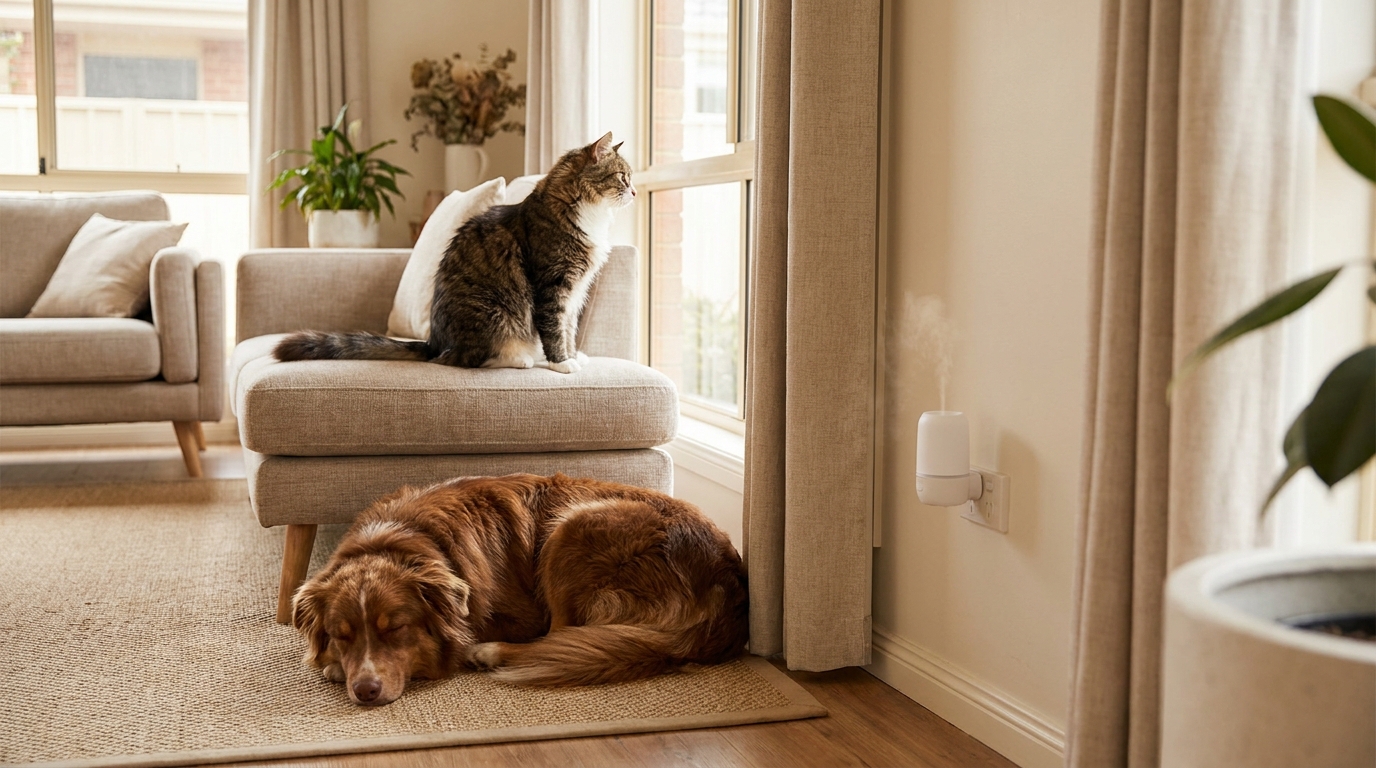
When comparing Adaptil and Feliway, the right pick is usually straightforward: Adaptil is formulated for dogs, while Feliway is formulated for cats. These plug-in diffusers use species-specific pheromones to help support a calmer environment at home during common stress periods.
This guide covers what to expect, how to choose the most suitable product variant, and how to set up your diffuser for the best chance of noticing positive day-to-day changes.
How calming diffusers work (and what to expect)
Pheromone diffusers release a synthetic version of the natural “comfort signals” dogs or cats produce to communicate familiarity and safety. Humans can’t smell these signals, but many pets respond with calmer, more settled behaviour in everyday situations.
It helps to think of a diffuser as background support rather than a quick fix. Some households notice changes within the first week, but it’s common for improvements to be gradual over several weeks—especially if you’re working through a bigger transition like moving, visitors staying over, or introducing a new pet.
Diffusers are often used during predictable stressors such as renovations, travel prep, fireworks season, or stormy weather. In many parts of Australia, sudden summer storms, heat-driven changes to routine (more time indoors), and holiday houseguests can all be common triggers, so setting up early can be worthwhile.
Adaptil vs Feliway: key differences at a glance
The main difference is species. Adaptil supports dogs and Feliway supports cats, and those pheromone signals aren’t interchangeable. If you’re doing a pheromone diffuser comparison, this matters more than any other feature.
- Best for: Adaptil for dogs; Feliway for cats.
- Common use cases: Dogs—settling at home, adjusting to alone time, noise events. Cats—changes in the home, multi-cat tension, scratching or marking-related stress.
- How it fits into a plan: Most helpful alongside routines, enrichment, and environmental management (rather than replacing them).
- Where to shop: Browse Adaptil calming options or Feliway calming options.
If you live with both dogs and cats, you may need a species-appropriate option for each rather than hoping one diffuser covers everyone in the household.
Choosing the right Adaptil or Feliway variant
Both brands have variants designed for different situations, so it’s worth matching the product to your goal (this can also help reduce “it didn’t work” frustration and unnecessary returns).
- Adaptil variants: You may see options aimed at general home calm, settling, or specific situations like travel/transport. Choose the one that best matches your dog’s main trigger (for example, at-home settling versus travel days).
- Feliway variants: Some versions focus on general environmental comfort, while others are targeted to multi-cat households or broader stress support. If the issue is tension between cats, pick the multi-cat focused option; if the issue is change or general stress, choose the general calm option.
If you’re unsure, start by describing the problem in one sentence (for example, “my cat is stressed since moving house” or “my dog struggles when left alone”) and choose the variant that’s clearly designed around that scenario.
Which diffuser is right for your pet and situation?
Start with your pet type, then map your choice to the trigger you’re trying to reduce. If you’re unsure whether the behaviour is anxiety-related or something else (like boredom or a learned habit), take note of when it happens, what happens right before it, and which changes make it better or worse.
- If you have a dog: Choose Adaptil when you’re supporting settling at home, adjusting to a new routine, coping with visitors, or managing common noise events. It can be a helpful “calmer baseline” while you work on training, confidence-building, and predictable routines.
- If you have a cat: Choose Feliway when you’re dealing with home changes (new furniture, moving, renovations), multi-cat friction, or stress behaviours such as hiding, tension around resources, or unwanted scratching in a particular zone.
Also consider the space you need to cover. Open-plan Australian homes may require more than one diffuser if your pet spends time in multiple areas (for example, living zone plus bedroom). In smaller apartments, one well-placed diffuser is often a sensible starting point.
Quick tip: Pick the room your pet uses most (sleeping area or favourite hangout), plug the diffuser there first, and keep doors open where possible so the effect can move into nearby spaces.
How to use a calming diffuser at home (setup tips)
Placement, airflow, and consistency make a real difference. Plug the diffuser into a clear wall socket (not behind curtains or furniture), and avoid power boards where airflow can be restricted or the unit may be knocked loose.
- Coverage: As a practical rule, one diffuser is usually intended to support one main living area. If you have an open-plan space with multiple “zones”, or if your pet sleeps in a separate room with the door closed at night, you may need an additional diffuser to support both areas.
- How long does a refill last? Many refills are designed to run for around a month when used continuously. If you’re finding it runs out quickly, check the room’s ventilation and make sure it’s plugged in upright and unobstructed.
- Where should I plug it in? Place it in the area where the problem happens most, or where your pet spends the most relaxed time (often the lounge room). In open-plan homes, prioritise the central area rather than a far corner. Keep it away from heat sources, direct sun through windows, and anything that could block air movement around the unit.
- Safety and comfort: Keep the space reasonably ventilated (especially in hot, humid months) and ensure pets can choose to move away—calm works best when they feel in control of their space.
Keep it running continuously for the period you’re targeting—especially during change-heavy weeks like moving house or the first few weeks with a new pet. If you only plug it in “when things go wrong”, you may miss the chance to build a calmer baseline.
Set realistic expectations and track “success” in small, measurable ways. Examples include: your dog settles within 5 minutes after the doorbell instead of 20; your cat uses the scratching post more often than the sofa; your pet returns to resting after a storm more quickly; or there’s less pacing, vocalising, or hiding across the week.
For best results, don’t forget the basics: daily play for cats, appropriate exercise and enrichment for dogs, and preventing rehearsals of unwanted behaviours (like repeatedly reacting at the window). A calming diffuser works best as one part of a whole-home plan.
Frequently Asked Questions
Can I use a dog pheromone diffuser for my cat (or vice versa)?
It’s not recommended, because the pheromone signals are species-specific. If you’re comparing Adaptil and Feliway, treat this as the key rule: choose the product made for your pet’s species.
How long does it take to notice a difference?
Some pets appear more settled within the first week, but many households see gradual improvement over a couple of weeks. Consistent use, correct placement, and reducing other stressors usually give the clearest results.
How many diffusers do I need?
Many homes start with one diffuser in the room where the pet spends the most time. You may need more than one if you have a large home, an open-plan layout with distinct areas, or if your pet spends significant time in a closed-off room (such as a bedroom at night). If behaviour concerns occur in two separate areas, consider supporting both areas rather than expecting one unit to cover the whole house.
Where should I plug it in in an open-plan home?
Aim for a central, uncluttered wall socket in the main living zone where your pet relaxes, rather than a corner behind furniture. Keep internal doors open where safe and practical, and avoid placing the unit near curtains, heaters, or air vents that could disrupt airflow.
Should I use a diffuser if my pet only gets anxious sometimes?
Yes—diffusers can be particularly helpful for predictable events like visitors, storms, fireworks, or travel prep. Starting early (before the trigger period) often works better than waiting until your pet is already distressed.
When should I speak to a vet or behaviour professional?
If your pet shows a sudden behaviour change, severe distress, or new issues such as urine marking, house-soiling, destructive scratching, or self-injury, it’s important to rule out medical causes and get tailored advice. Pain, urinary issues, skin irritation, and other health problems can look like “anxiety”, and some cases need a structured behaviour plan from a qualified professional in addition to calming support products.
Ready to choose? Compare options in our Adaptil range and Feliway range to find the best fit for your home—then, if you’re concerned about severe or escalating anxiety, chat to your vet.