


Automatic pet feeders can be a genuine quality-of-life upgrade—especially if you’re balancing early starts, shift work, school runs, or weekends away. But “better value” isn’t always the cheapest option or the one with the most buttons. It’s the feeder that keeps meals consistent, stays easy to clean, and doesn’t create new problems (like noisy dispensing that spooks an anxious pet, kibble that jams, or parts that don’t fit back together properly after washing).
This guide breaks down what value really looks like in an automatic cat feeder or automatic dog feeder, when a simpler alternative might suit you better, and how to choose quickly based on your pet’s routine and your home setup.
What “better value” really means for automatic pet feeders
Value is the total experience over months (and years), not just the price tag. A timed feeder or smart feeder that saves time but is fiddly to clean, jams often, or startles your pet at every meal can end up costing more in replacement parts, wasted food, or daily frustration.
- Reliability: consistent dispensing without frequent jams or misfeeds—especially important if you’re relying on it for the first meal of the day.
- Food compatibility: the feeder needs to suit the kibble size and shape. Small cat kibble and tiny dog kibble usually flow more easily than larger, chunky pieces designed for big dogs.
- Cleaning ease: parts that come apart logically and wash well—important in warm, humid periods when smells build quickly.
- Noise and drop style: how loudly kibble falls into the bowl can matter as much as the motor volume.
- Portion control & schedule stability: predictable meal times can help many pets settle, particularly in busy households.
- Build quality: sturdier lids and bases reduce spills, pests, and opportunistic snacking.
In many Australian homes, climate plays a part too. Hot summers can make food go stale faster and attract insects, so designs that seal well and stay hygienic can be better value even if they cost more upfront. If you’re in a humid coastal area, you’ll often notice freshness and cleaning requirements more quickly than you would in cooler months.
Where premium automatic feeders tend to be better value
Higher-quality automatic feeders tend to win on the boring things that matter most day to day: they’re less likely to jam, easier to maintain, and more predictable for your pet. If you rely on a timed feeder while you’re out—long commutes, late shifts, or school pickup—consistency is the real “feature”.
Premium models are often better value if:
- You have a clever pet (or a determined dog): sturdier lids and better seals can help prevent break-ins.
- You need routine to stay consistent: stable scheduling is useful for pets that get anxious with change.
- You’ll use it daily: small annoyances (awkward cleaning, loud motors, hard-to-read controls) add up fast when you’re doing them every day.
- You’re choosing between cat vs dog needs: cats often do well with smaller, more frequent meals, while many dogs do better with fewer set mealtimes—either way, a dependable schedule helps.
- You want smarter control: a smart feeder can be handy for changing meal times remotely or checking whether a meal dispensed as planned (useful on unpredictable days).
For Australian buyers, “better value” also includes practicalities like local warranty coverage, responsive support, and the ability to keep feeding going during outages. If you’re comparing models, check whether it can run on batteries as a backup, and whether the controls still work if your Wi‑Fi drops out.
Safety note: Automatic feeders are a convenience tool—not a replacement for fresh water access, supervision, or veterinary advice. Avoid relying on a feeder for medication timing or for pets with diet-controlled medical conditions (such as diabetes or structured weight plans) without guidance from your vet.
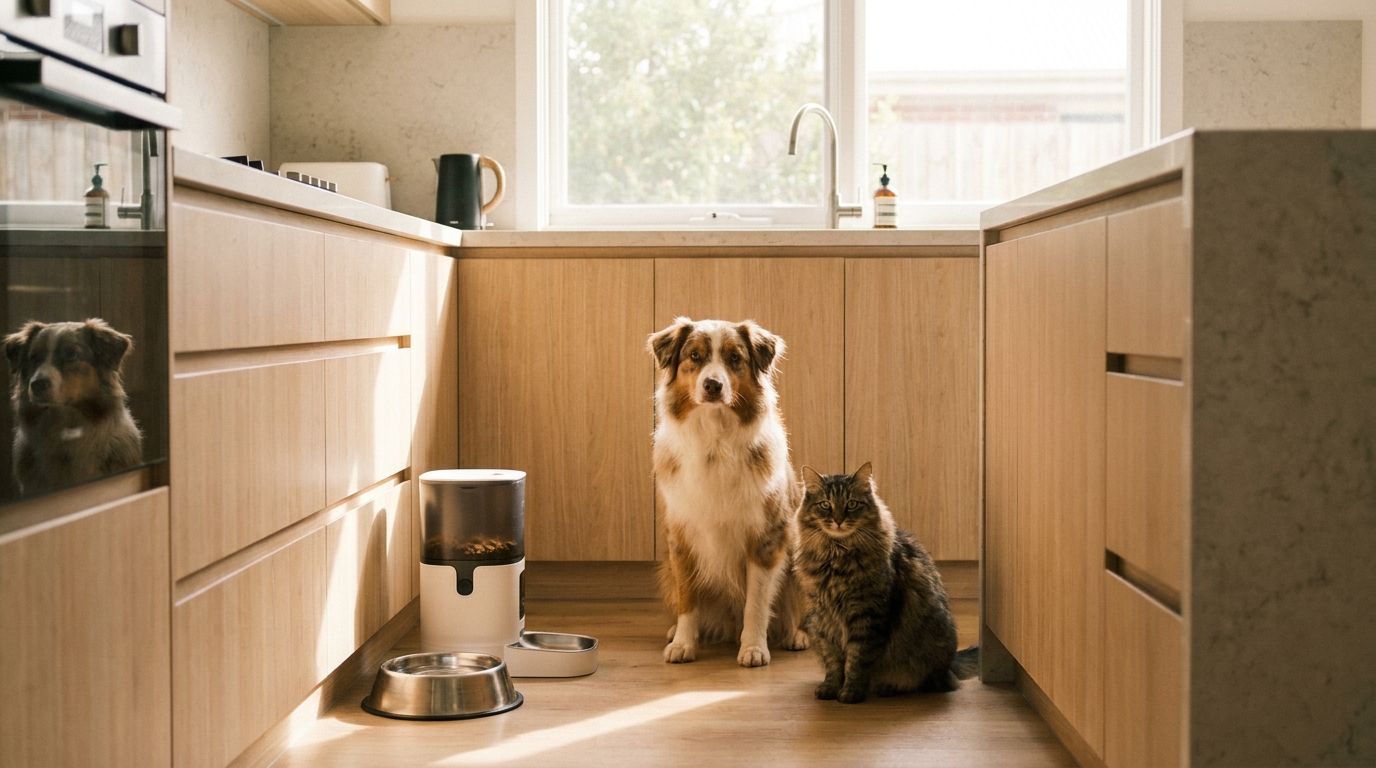
When alternatives may suit you better
Automatic feeders aren’t the right answer for every pet or household. Sometimes the best value is a simpler approach that still supports healthy routines.
Alternatives may suit you better when:
- You feed wet food (or mixed feeding): most dry-food dispensers aren’t designed for wet food. If your cat eats wet food for hydration support, consider options made for that purpose, such as a rotating compartment feeder; some versions include an ice-pack compartment to help keep food cooler for longer on warm days.
- Your dog eats large kibble: bigger pieces can be more prone to jamming in some dispensers. A simpler solution may be more reliable if your food is chunky or irregularly shaped.
- Your pet needs supervision at meals: some dogs wolf food, some cats graze and then suddenly overeat, and multi-pet households can involve guarding or stealing. In these cases, being present can matter more than automation.
- Your household has more than one pet with different diets: multi-pet feeding is where things get tricky. If one pet steals the other’s food, look for options that allow separation, or (for some homes) microchip/RFID-style access control so the right pet gets the right bowl.
- Your pet startles easily: the motor sound or the sudden clatter of kibble can be a dealbreaker for some cats and small dogs. A non-dispensing compartment feeder or a slow feeder may feel less “sudden”.
Also keep in mind: the “cheapest today” option can become expensive if it’s hard to clean, noisy, or unreliable. A feeder that ends up unused in a cupboard is the worst value of all.
A quick comparison checklist (with examples)
To make value claims practical, use a simple checklist. Below is a mini-comparison using common types of feeders (not brands), so you can match the style to your pet and routine. Keep in mind that noise level and anxious-pet suitability vary widely by model even within the same category.
| Option type | Typical price range (AUD) | Best for | Cleaning ease | Noise level | Suitability for anxious pets | What to watch for |
|---|---|---|---|---|---|---|
| Basic timed dry-food feeder | $50–$150 | Simple routines, single-pet homes, dry food only | Varies; often average | Low to medium (varies by motor and kibble drop) | Mixed (depends on sound, bowl shape, and how “sudden” dispensing feels) | Kibble size limits, small buttons, tricky lids, inconsistent portions |
| Smart connected dry-food feeder | $150–$350 | Shift work, travel days, tighter scheduling, people who want monitoring | Usually better-designed parts | Low to medium (model dependent) | Often better if dispensing is smoother and predictable | Wi‑Fi setup, app reliance, more components to clean; check battery backup for outages |
| Multi-meal compartment feeder (non-dispensing) | $40–$120 | Cats and small dogs, quieter feeding, some wet-food routines | Often easiest | Low (usually just a rotate/cover action) | Often strong (less clatter), but varies by click/rotation noise | Limited capacity; not ideal for big kibble; some pets try to pry compartments |
| Slow feeder bowl / puzzle feeder (manual) | $15–$60 | Dogs that eat too fast, enrichment for indoor cats, anxious pets who do better with calming routines | Usually easy | Low (no motor) | Often good, especially for noise-sensitive pets | Not a timed option; choose an appropriate difficulty so it doesn’t frustrate your pet |
Warranty check: Whatever type you choose, look for clear warranty terms and local support, and keep the box and receipt for the first few weeks while you confirm it suits your pet. In Australia, it’s also worth checking power compatibility (if it plugs in) and whether the unit can run on batteries during a blackout.
How to choose the right feeder in 5 minutes
If you want a fast, low-regret decision, choose based on routine, pet personality, and cleaning reality—not marketing features.
- Step 1: Confirm what you’re feeding. Dry food only, or do you need wet food support? If wet food is part of the plan, look at compartment-style feeders (and consider ice-pack styles in summer).
- Step 2: Check kibble size. If you have a large-breed dog or oversized kibble, prioritise a dispenser designed for bigger pieces to reduce jams.
- Step 3: Map your schedule. If you only need help once a day, a basic timed feeder may be enough. If you rely on it daily, prioritise reliability, easy cleaning, and battery backup.
- Step 4: Consider temperament. For anxious pets, avoid sudden loud dispensing. Choose quieter mechanisms, introduce it gradually, and keep the feeding location consistent.
- Step 5: Think about multi-pet reality. If one pet steals food, automation can backfire. Separate feeding stations, supervision, or microchip/RFID access can be the better “value” choice because it protects each pet’s diet.
If you’re comparing options with an eye on after-sales support and replacement parts, you can also explore the broader Yealink range.
Frequently Asked Questions
Are automatic pet feeders good value?
They can be—when they genuinely support your routine and your pet’s wellbeing. The best value usually comes from consistent feeding times, easy cleaning, and a design your pet isn’t scared of. A smart feeder can add convenience, while a basic timed feeder can be enough for simple schedules.
Is an automatic cat feeder different from an automatic dog feeder?
Often, yes in practice. Cats commonly do well with smaller, more frequent meals and smaller kibble; dogs may need larger portions and may be more likely to knock or “test” a feeder. Check capacity, bowl stability, and kibble-size compatibility for your pet.
What’s best for multi-pet homes where one pet steals food?
Look for ways to control access or separate pets at meals. In some households, microchip/RFID access bowls or feeders can help ensure the right pet gets the right food. If that’s not an option, supervised feeding or separate rooms may be the simplest solution.
When should I avoid relying on an automatic feeder?
If your pet has a medical condition that requires close monitoring or a vet-directed diet plan, don’t make changes without veterinary guidance. Also avoid using a feeder as a substitute for fresh water access, and don’t use it to manage medication timing.
How can I help my pet adjust to a new feeder?
Introduce it gradually: place it near the usual bowl, let your pet sniff it, and run a few “practice” dispenses while you’re home. Keep the first days calm and consistent, and avoid sudden changes to feeding location or timing if your pet is sensitive to routine.
Ready to compare options for your home setup? Browse our Yealink range and use the same value checklist—reliability, ease of use, and low day-to-day hassle—to choose gear you’ll actually stick with.